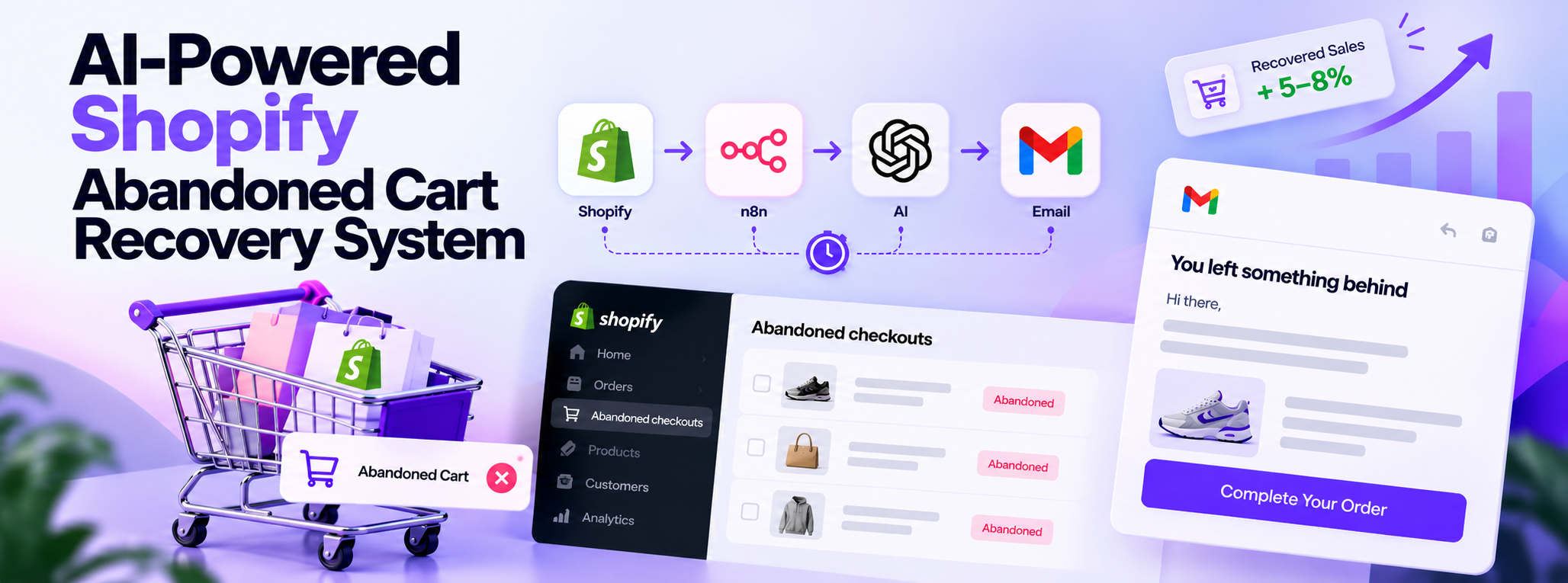
AI-Powered Shopify Abandoned Cart Recovery System
An always-on automation that detects abandoned Shopify carts and sends personalized, AI-written recovery emails.
 n8n Automations
 Make Automations AI Agents AI Agents for Ecommerce
- n8n
- Make
- Shopify
- Gmail
- OpenAI
01. The Problem: Abandoned Carts Were Leaving Revenue on the Table
Before automation, abandoned carts were often handled manually or received no follow-up at all.
- Teams had to check Shopify manually for abandoned checkouts.
- Writing reminder emails took time and effort.
- Follow-ups were inconsistent, and many carts were never contacted.
- Generic emails lacked personalization.
- Delayed reminders reduced the chance of customers completing their purchases.
The Cost of Manual Follow-Ups
For stores handling 40–60 abandoned carts per day:
- Each follow-up took approximately 5–7 minutes.
- Manual work could consume 3–5 hours daily.
- Some stores followed up only once a day or skipped follow-ups entirely.
Without timely reminders, potential sales were lost.
02. Results After Automation
The automated workflow ensures abandoned checkouts receive timely, personalized recovery emails with minimal human intervention.
- 100% recovery-attempt coverage: Every detected abandoned cart receives a recovery attempt.
- 90–95% less manual work: Repetitive follow-up tasks are automated.
- Faster communication: Recovery emails are sent within the configured time window.
- AI personalization: Each email is generated to provide a relevant, friendly reminder.
Time Savings
| Metric | Before Automation | After Automation |
|---|---|---|
| Follow-up process | Manual | Automated |
| Time per cart | Approximately 6 minutes | Minimal manual effort |
| Daily workload | Around 3–5 hours | Near-zero routine effort |
| Monthly time savings | — | Approximately 100–120 hours |
Potential Revenue Impact
Using a conservative example of 50 abandoned carts per day, a $50 average cart value, and a 5–8% recovery rate:
- Potential recovered sales: $125–$200 per day.
- Potential recovered sales: Approximately $3,750–$6,000 per 30-day month.
These figures are illustrative estimates, not guaranteed results. Actual performance depends on store traffic, customer behavior, email deliverability, and conversion rates.
03. The Solution: AI-Powered Abandoned Cart Recovery
The system works as an always-on sales assistant that follows up with customers automatically.
It:
- Detects abandoned Shopify checkouts.
- Waits for a configured period before sending a reminder.
- Verifies that the checkout is still abandoned and has not been completed.
- Uses AI to generate a personalized recovery email.
- Sends the email automatically through Gmail or a configured email service.
The workflow operates in the background, reducing repetitive work while keeping follow-ups consistent.
04. How the Automation Works
The workflow connects Shopify, an automation platform, AI, and email delivery.
- Abandoned Checkout Detection: Shopify provides abandoned checkout data.
- Wait and Verify: The automation waits and checks whether the checkout remains abandoned.
- AI Email Generation: OpenAI generates a friendly, personalized recovery message.
- Email Delivery: Gmail or the configured email service sends the message to the customer.
- Scheduled Execution: The workflow runs automatically according to its configured schedule.
Workflow:
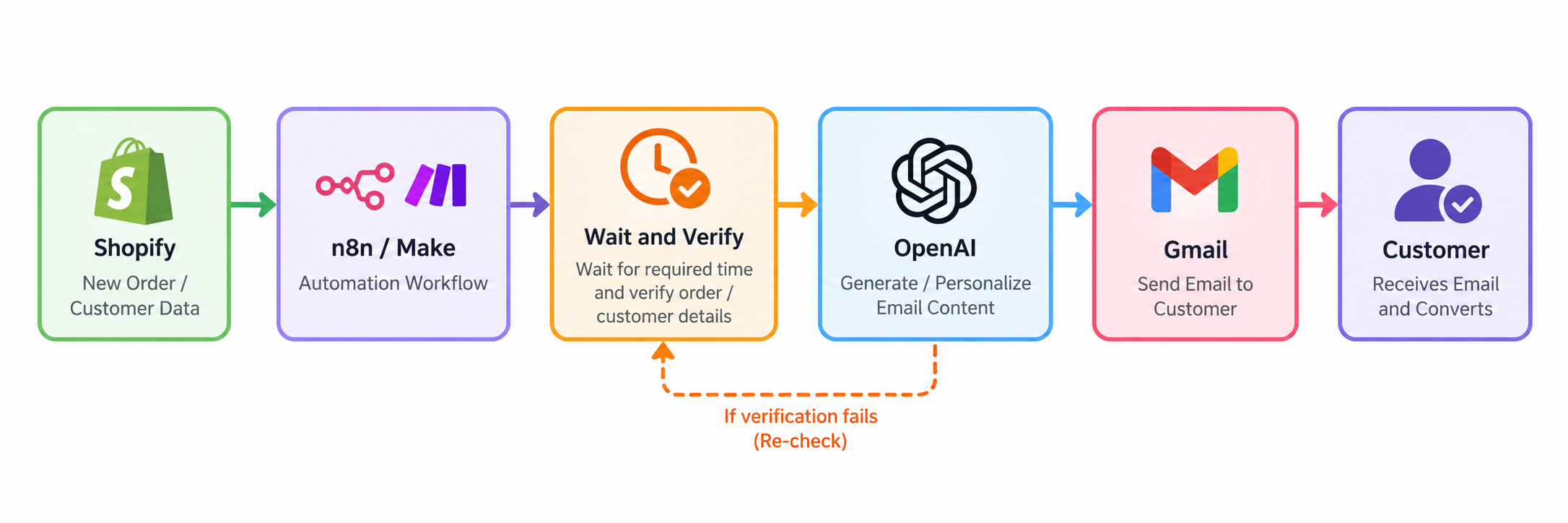
No routine manual follow-up is required once the workflow is configured and activated.
05. Business Value
Recover Potential Revenue
Re-engages customers who leave products in their carts and creates another opportunity to complete a purchase.
Reduce Manual Work
Eliminates repetitive checkout monitoring and email-writing tasks.
Improve Customer Experience
Delivers timely reminders with more relevant, personalized messaging.
Ensure Consistent Follow-Ups
Provides a recovery attempt for every detected abandoned checkout that meets the workflow conditions.
Scale With Store Growth
Handles increasing checkout volumes without requiring a proportional increase in manual effort.
06. How to Replicate the System
Use the provided workflow blueprint to configure the automation in Make.com.
Step 1: Import the Blueprint
- Open the attached JSON file: Shopify Abandoned Checkout Recovery with Order Verification (1).json.
- Select and copy the complete JSON content.
- Log in to Make.com and open Scenarios.
- Create a new scenario and choose the blueprint import option.
- Import the JSON, save the scenario, and name it Shopify Abandoned Checkout Recovery with Order Verification.
Step 2: Configure Shopify
- Connect your Shopify account.
- Confirm that the workflow retrieves abandoned checkouts.
- Verify that the checkout status and required customer fields are mapped correctly.
Step 3: Configure the Wait and Verification Logic
- Review the delay before sending the recovery email.
- Verify that the checkout has not been completed.
- Prevent duplicate or unnecessary recovery emails.
Step 4: Configure OpenAI
- Add your OpenAI API key.
- Confirm that the AI generates a relevant, friendly recovery email.
- Check that the email body follows your desired format and tone.
Step 5: Configure Email Delivery
- Reconnect Gmail or your SMTP email service.
- Map the customer's email address dynamically.
- Set the email subject to You left something behind.
- Verify the recipient, subject, and generated email body.
Step 6: Test and Activate
- Run the scenario once.
- Verify that abandoned checkout data is retrieved.
- Confirm that the checkout verification works.
- Check that the AI-generated email is correct.
- Confirm that the recovery email is delivered successfully.
- Activate the scenario and configure an appropriate schedule, such as every 15–60 minutes.
Important: The actual schedule, delay, and verification rules should match your store's requirements and the imported workflow configuration.
07. Final Outcome
The AI-Powered Shopify Abandoned Cart Recovery System transforms abandoned checkouts into automated follow-up opportunities.
By combining Shopify checkout data, workflow automation, AI-generated emails, and automated delivery, the system helps businesses:
- Follow up consistently with abandoned carts.
- Reduce repetitive manual work.
- Deliver timely, personalized reminders.
- Create additional opportunities to recover lost sales.
- Scale their recovery process as the business grows.
The result: A reliable, always-on abandoned cart recovery workflow that supports revenue recovery without increasing routine workload.