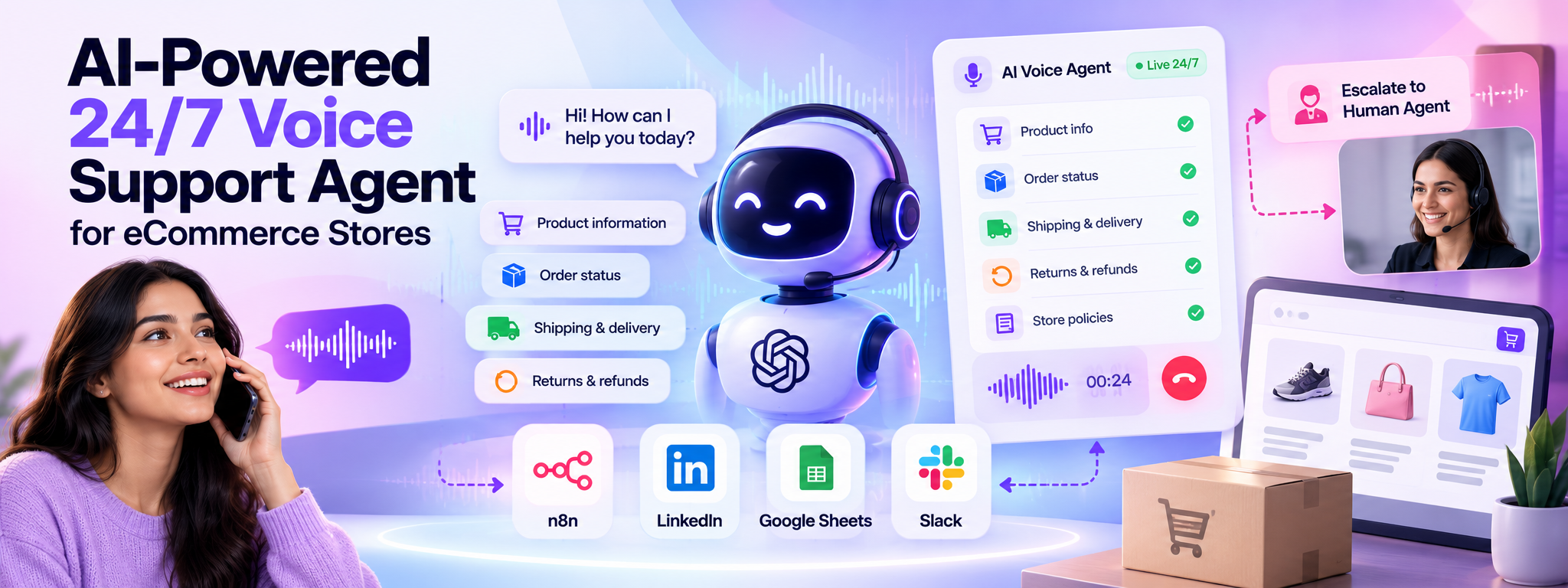
AI-Powered 24/7 Voice Support Agent for eCommerce Stores
A 24/7 AI voice agent that answers store calls using your product and policy data, escalating only complex calls to humans.
 n8n Automations AI Agents AI Agents for Ecommerce
- n8n
- Slack
- Google Sheets
Project Overview
The AI-Powered 24/7 Voice Support Agent automates customer support calls for eCommerce stores using conversational AI and a centralized knowledge base. Built around VAPI, n8n, Slack, and Google Sheets, it can answer common questions about products, pricing, shipping, returns, and store policies through natural voice conversations.
The system understands customer intent, retrieves relevant store information, responds in real time, and supports optional escalation for complex or high-risk issues. This reduces repetitive work for support teams while providing customers with access to assistance around the clock.
Technologies: VAPI · n8n · Slack · Google Sheets · AI Voice Agent
01. The Problem: Support Calls Don’t Scale
Before automation, customer support teams handled incoming calls manually.
Common challenges included:
- Repeating answers about products, sizes, shipping, returns, and order status.
- Switching between store systems and knowledge documents during calls.
- Missing calls during peak hours or outside business hours.
- Providing inconsistent answers depending on the agent handling the call.
Impact per team
- Long wait times and dropped calls.
- Frustrated customers seeking answers to basic questions.
- Inconsistent use of product and policy information.
- High dependency on human agents for repetitive FAQs.
Core challenge: Build a 24/7 support system that can resolve common customer queries using the store’s own knowledge while escalating issues that require human attention.
02. Results After Automation
After implementation, the voice agent can answer calls around the clock and handle common customer questions automatically.
Key improvements
- Calls answered without waiting for a human agent.
- Common FAQs handled through conversational AI.
- Complex or high-risk issues escalated when required.
- Responses grounded in available store product and policy information.
- Human agents able to focus on more complex customer needs.
Time and effort savings
Before
- Approximately 100–200 repetitive calls per week.
- Around 2–3 hours per day spent answering FAQs.
After
- Routine call handling automated.
- Human involvement primarily reserved for escalations and exceptions.
Estimated monthly impact
- Approximately 40–60 hours saved per support team.
- More time available for complex and high-value support cases.
Consistency improvements
- Responses use the configured product and policy knowledge base.
- Reduced reliance on improvised answers.
- Easier alignment with updated store information when the knowledge base is maintained.
03. The Solution: AI-Powered Voice Agent
The system acts as a virtual customer support representative capable of handling common eCommerce questions independently.
It:
- Provides natural, conversational voice responses 24/7.
- Uses store knowledge covering products, pricing, inventory, policies, and FAQs.
- Answers common questions without requiring a human agent.
- Maintains conversational context across follow-up questions.
- Supports optional escalation for complex or high-risk calls.
- Can send call summaries and capture relevant information through n8n, Slack, and Google Sheets.
04. How the System Works
Phase 1: Knowledge Base and Store Data
Relevant store information is collected and organized for retrieval during calls.
This may include:
- Product details, sizes, colors, and availability.
- Pricing and promotions.
- Shipping fees and delivery times.
- Return, refund, and exchange policies.
- Frequently asked questions.
The knowledge base should be kept up to date to reduce the risk of outdated responses.
Phase 2: Incoming Call and Intent Detection
- A customer calls the support number.
- VAPI answers with a configured greeting and voice.
- The customer's speech is converted into text.
- AI identifies the intent, such as a product question, order inquiry, or policy clarification.
Phase 3: Knowledge Base Lookup
The system retrieves relevant information to answer the customer's question.
For example:
- Product specifications and availability.
- Delivery timelines and shipping costs.
- Return and refund conditions.
- Promotions and bundles.
- Order details for authenticated users, where the required integration is configured.
Phase 4: Voice Response Generation
- AI prepares a relevant, conversational answer.
- Text-to-speech generates the spoken response.
- The answer is played to the customer in real time.
Phase 5: Multi-Turn Conversation
The agent maintains context throughout the call, allowing customers to ask follow-up questions about products, orders, and policies without restarting the conversation.
Phase 6: Human Escalation and Call Summary
When configured, complex or high-risk calls can be forwarded to a human agent. The workflow may also support callback requests or ticket creation.
After the call:
- VAPI sends call-end information to an n8n webhook.
- n8n processes the call summary and relevant details.
- Slack receives the summary.
- Google Sheets records applicable information.
05. Business Value
- 24/7 Availability: Customers can receive assistance outside normal business hours.
- Reduced Support Workload: AI handles repetitive FAQs automatically.
- Consistent Answers: Responses are based on configured store knowledge.
- Faster Resolution: Common questions can be answered in a short conversation.
- Better Knowledge Utilization: Product and policy information supports customer interactions.
- Human Escalation: Complex cases can be routed to people when required.
- Call Visibility: Summaries and captured details can be recorded for follow-up.
06. Expected Impact
Time Savings
Automating repetitive calls reduces the time support agents spend answering routine questions, allowing them to focus on complex issues.
Error Reduction
Using maintained product and policy data helps reduce inconsistent or improvised answers.
Call Handling Speed
Common questions can potentially be resolved in one or two exchanges, depending on their complexity.
Knowledge Utilization
Centralized store information can be reused across voice interactions, improving consistency and accessibility.
Estimated time savings: Approximately 40–60 hours per month per support team, depending on call volume and automation coverage.
07. Workflow Architecture
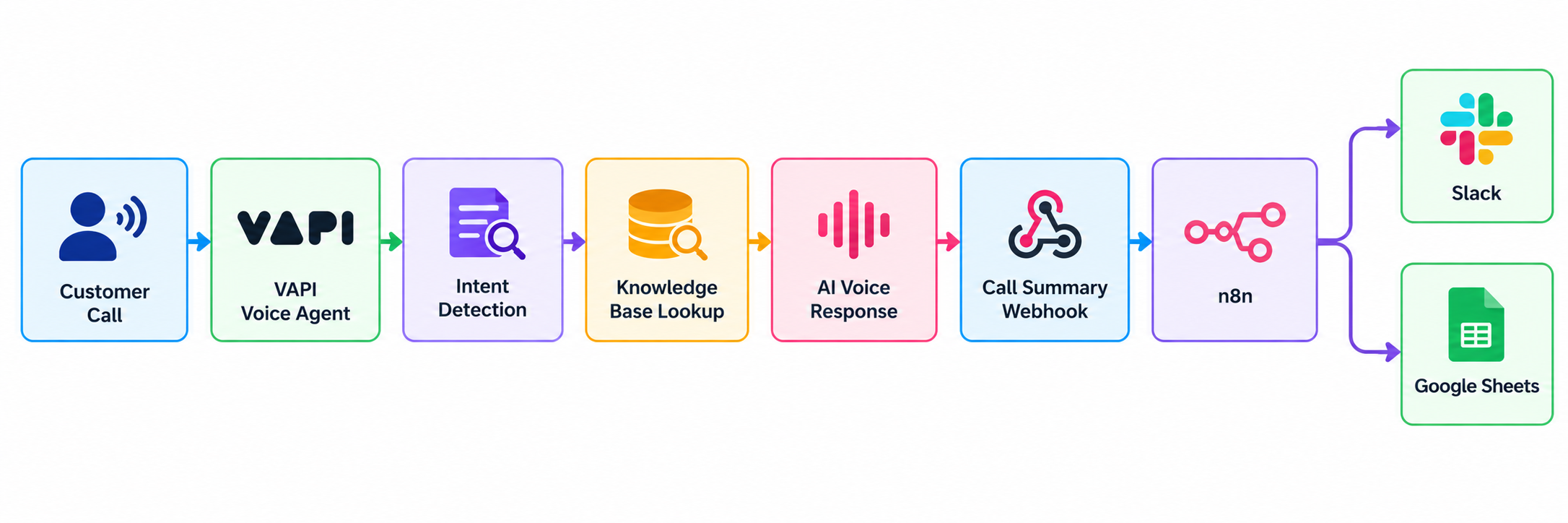
The main components work together as follows:
- VAPI: Handles voice interactions and call management.
- Knowledge Base: Supplies relevant product and policy information.
- AI Processing: Understands customer questions and prepares responses.
- n8n: Processes call-end events and coordinates follow-up actions.
- Slack: Delivers call summaries to the support team.
- Google Sheets: Stores applicable call records and captured information.
08. How to Replicate the System
Step 1: Configure the VAPI Voice Agent
- Create the voice agent and configure its greeting and voice tone.
- Connect the store knowledge base.
- Test its ability to answer FAQs and product or policy questions.
Step 2: Configure the Call-End Webhook
- Create a webhook node in n8n.
- Configure VAPI to send call-end information to the webhook.
- Verify that the webhook receives the expected call details.
Step 3: Import the n8n Workflow
- Open
ShopTalk AI – Call Summary & Lead Capture (1).json. - Import the workflow into n8n.
- Connect the VAPI webhook to the workflow.
- Configure Slack and select the appropriate summary channel.
- Connect Google Sheets and select the spreadsheet and required columns.
Step 4: Test the Flow
- Make a test call.
- Ask product or policy questions.
- Test a follow-up question.
- End the call.
- Verify that the call summary appears in Slack.
- Confirm that a row is added to Google Sheets when applicable.
Step 5: Activate the Workflow
Once testing is complete, activate the n8n workflow and verify that the VAPI webhook is configured correctly.
The voice agent can then handle customer calls continuously, while n8n processes call summaries and related follow-up actions.
09. Final Outcome
The AI-powered voice support system transforms repetitive customer support calls into a more consistent and scalable operation.
- Customers can receive answers at any time.
- Human agents spend less time handling repetitive FAQs.
- Product and policy information supports consistent responses.
- Complex issues can be escalated when necessary.
- Call summaries and relevant records improve follow-up visibility.
- Support teams can handle routine demand without relying exclusively on additional staff.
The result: A scalable, 24/7 voice support experience that reduces repetitive work while keeping human agents available for the issues that need them most.