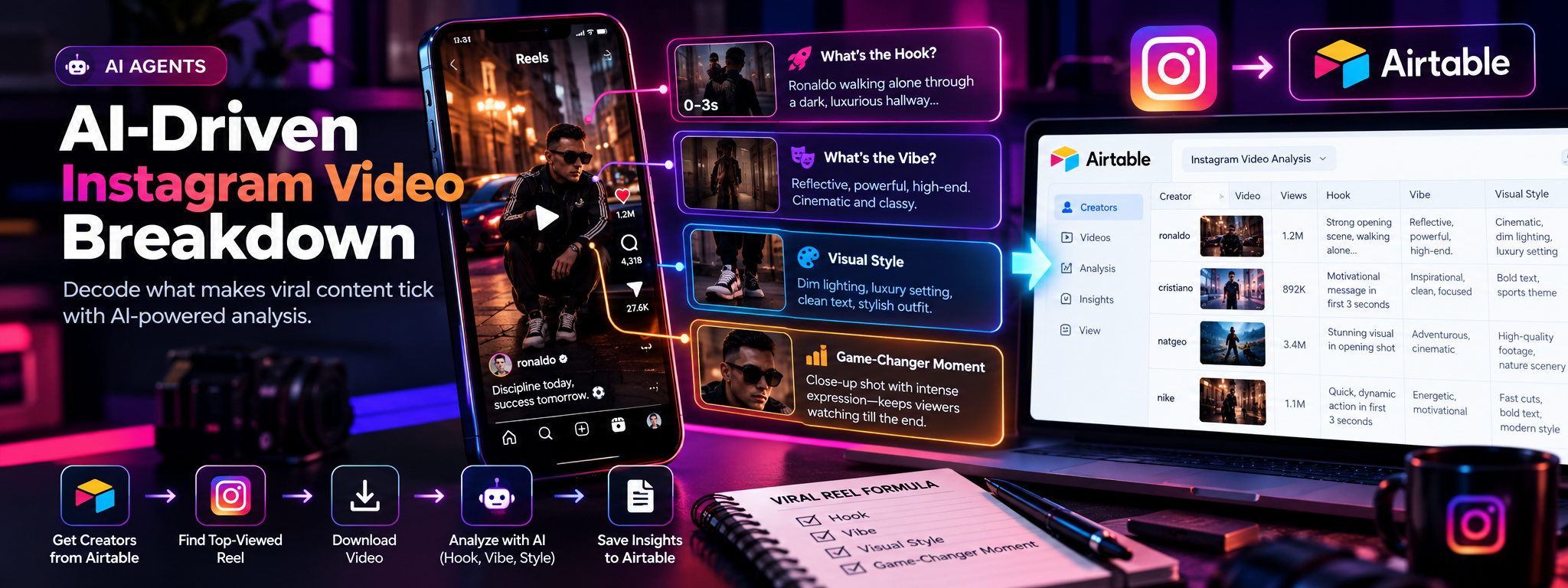
AI-Driven Instagram Video Breakdown: Decode What Makes Viral Content Tick
Automatically fetch and analyze top-performing Instagram videos from popular creators to uncover what makes them stand out.
- Airtable
Project Overview
Understanding why an Instagram Reel performs well requires more than looking at its view count. The opening hook, visual presentation, setting, storytelling, and memorable moments can all provide useful insights for content planning.
This project automates the process of identifying high-performing videos from selected Instagram creators and analyzing their creative elements. The workflow retrieves creator usernames from Airtable, identifies each creator’s most-viewed Reel, collects its details, downloads the video for analysis, and uses AI to generate a structured breakdown.
The resulting insights are saved back to Airtable, creating a searchable reference for reviewing successful content and informing future creative decisions.
01. The Challenge
Content research can become repetitive when teams manually review creators, compare video performance, and document what makes individual Reels engaging.
The main challenges include:
- Finding High-Performing Content: Identifying the strongest-performing Reel for each creator requires reviewing video performance data.
- Manual Video Research: Collecting links, captions, creator names, and view counts takes time when handled individually.
- Understanding Creative Techniques: View counts alone do not explain how a video attracts attention or maintains viewer interest.
- Inconsistent Analysis: Without a consistent framework, different videos may be reviewed using different criteria.
- Scattered Research Notes: Video observations can be difficult to organize and revisit when they are not stored in a structured database.
02. Project Objectives
The workflow was designed to automate video discovery and provide a consistent framework for analyzing creative content.
Its objectives are to:
- Retrieve Instagram creator usernames from Airtable.
- Identify the highest-viewed Reel available for each creator.
- Capture essential video information, including the link, caption, creator name, and view count.
- Download the selected video for closer analysis.
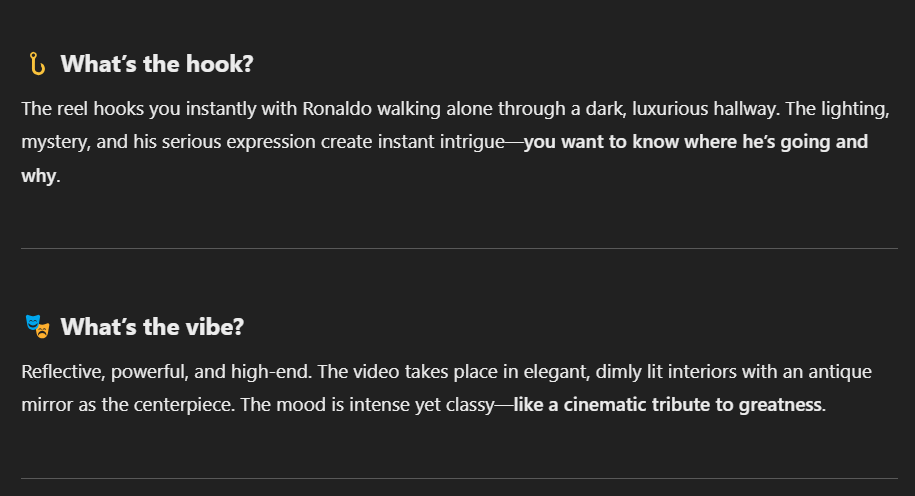
- Use AI to examine the opening hook, overall mood, visual style, and standout moments.
- Store the resulting analysis in Airtable for future reference.
03. The Solution
The solution combines Airtable-based creator tracking, automated video discovery, video downloading, and AI-assisted content analysis in a single workflow.
Rather than requiring a person to research and document every video manually, the workflow processes creator records, selects a top-performing Reel, and organizes its information for analysis.
The AI analysis focuses on four core areas:
Opening Hook
Examines how the video captures attention in its opening seconds, including the opening scene, action, or message that encourages viewers to keep watching.
Mood and Setting
Reviews the atmosphere of the video, including its background, environment, lighting, and overall energy.
Visual Style
Examines presentation elements such as on-screen text, clothing, framing, and other visible creative choices that contribute to the video's appearance.
Standout Moments
Identifies memorable or attention-grabbing moments that may help explain why viewers continue watching the video.
These observations are organized into a structured output and saved to Airtable alongside the relevant video information.
04. How It Works
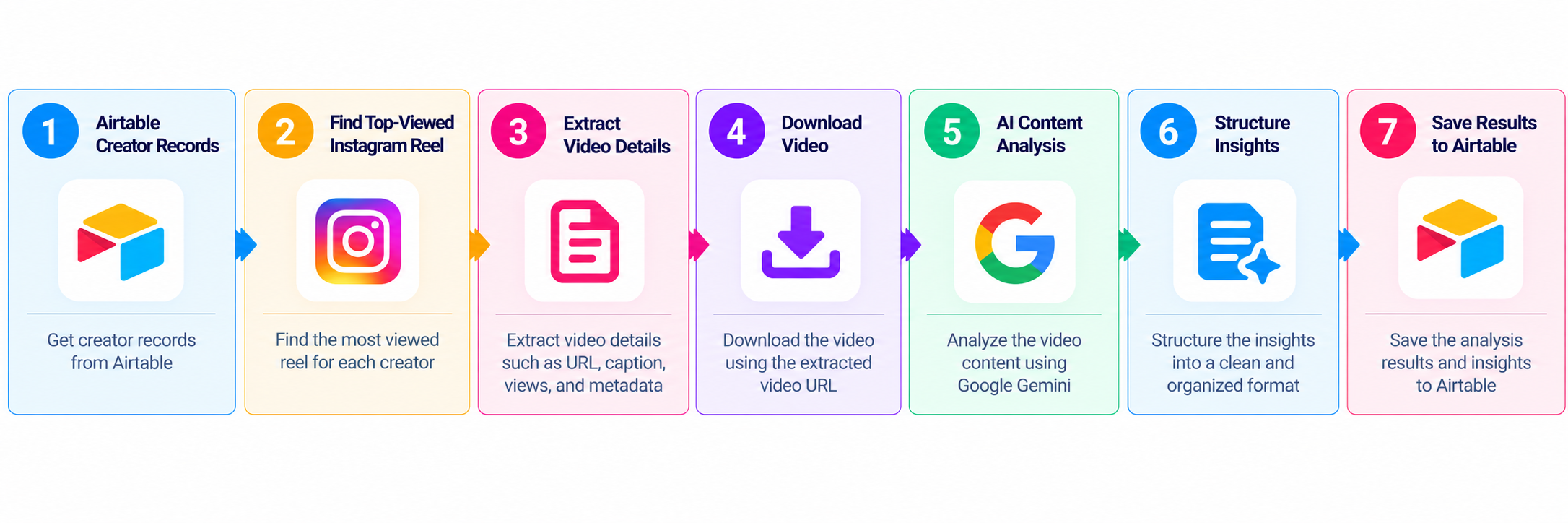
- Retrieve Creators: Read Instagram usernames from Airtable.
- Find the Top Reel: Identify the most-viewed available Reel for each creator.
- Collect Video Details: Capture the video link, caption, creator name, and view count.
- Download the Video: Prepare the selected Reel for closer analysis.
- Analyze with AI: Examine the hook, mood, visual style, and standout moments.
- Save the Insights: Write the structured analysis back to Airtable.
Demo:
05. Workflow
06. Key Features
- Automated Creator Research: Uses Airtable as the source for Instagram creator usernames.
- Performance-Based Selection: Focuses on the most-viewed available Reel for each creator.
- Video Metadata Collection: Organizes essential information about each selected video.
- AI-Assisted Creative Analysis: Applies consistent analysis criteria to the selected content.
- Structured Content Breakdown: Separates observations into hook, mood, visual style, and standout moments.
- Centralized Results: Stores video information and analysis in Airtable.
- Scheduled Execution: Supports daily, weekly, or monthly scheduling when configured in the automation platform.
07. Technology Stack
| Technology | Purpose |
|---|---|
| Source of creator videos and Reel content | |
| Airtable | Stores creator records, video details, and analysis results |
| Automation Workflow | Coordinates video discovery, downloading, analysis, and data storage |
| AI Analysis | Examines the video's creative and storytelling elements |
Note: The exact AI provider and video-downloading service are not specified in the supplied case study details.
08. Business Benefits
Faster Content Research
Automates repetitive steps involved in finding videos and collecting their key information.
More Consistent Analysis
Uses a common set of creative criteria to review videos, making observations easier to compare.
Organized Creative Intelligence
Keeps video metadata and analysis together in Airtable rather than scattered across separate notes.
Better-Informed Content Planning
Provides a structured reference for exploring hooks, visual presentation, storytelling, and other creative techniques used in high-performing videos.
09. Conclusion
The AI-Driven Instagram Video Breakdown workflow turns video research into a more organized and repeatable process. By combining creator tracking, Reel selection, video downloading, AI-assisted analysis, and Airtable storage, it helps transform individual videos into structured creative insights.
The result is a centralized content research process that makes it easier to review successful Reels, compare creative approaches, and use documented observations to guide future content planning.